Pittsburgh NPR — WESA: Following damaging reports, PA Congressman Marino defends his opioid law
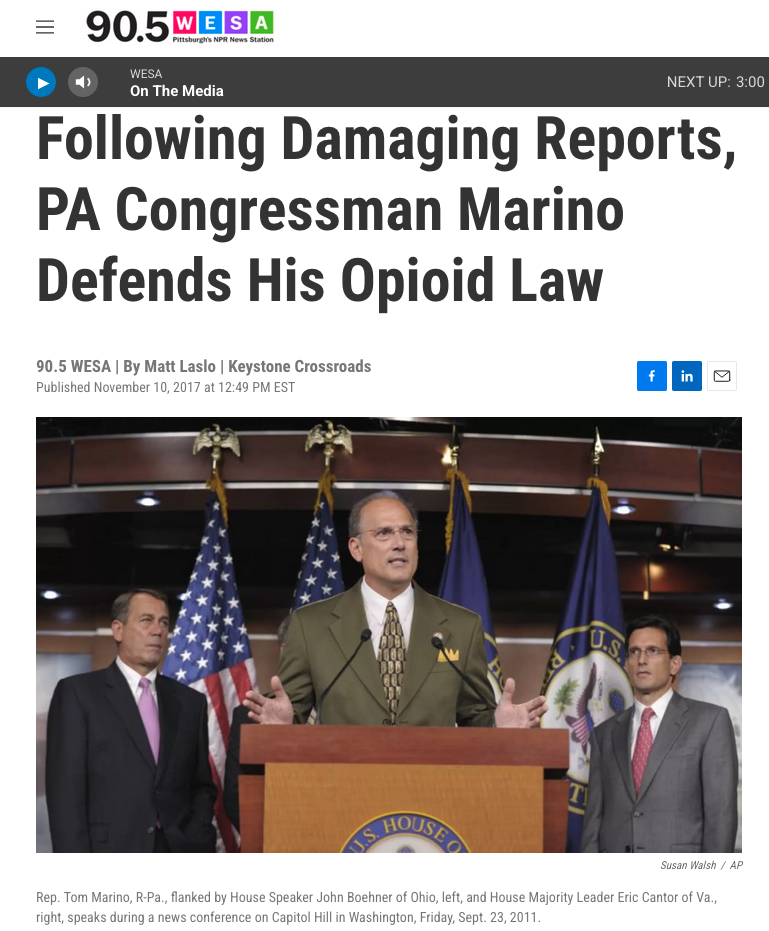
By Matt Laslo | Keystone Crossroads
Last month, The Washington Post and “60 Minutes” ran a damaging story about Pennsylvania Republican Congressman Tom Marino, (PA-10), which accused him of ushering a bill through Congress that tied the Drug Enforcement Agency’s hands in their effort to stop distributors from flooding the black market with opioid painkillers.
Whistleblowers in the DEA say the bill has directly interfered with their attempts to stem the nation’s opioid crisis.
In the fallout following publication, Marino withdrew himself from consideration for the director of the Office of National Drug Control Policy, a position known as “drug czar.”
Marino, the former Lycoming County District Attorney, declined to be interviewed for the initial story. He has since released statements on his website and published an opinion piece defending himself in The Hill, but has largely denied interview requests.
Keystone Crossroads met with Marino in his Capitol Hill office this week.
“It’s a typical hatchet job,” Marino said of the reports.
Marino says the purpose of his bill is to ensure access to opioids to people who truly need them. He says he was compelled to act after speaking in 2012 with one of his constituents, a local pharmacist.
“He brought up the fact that ‘I can’t get prescription drugs, pain pills, for my customers that are terminally ill,’” Marino said.
“When I directed my staff to research what was happening in the supply chain, they found that disrupted access to needed medications was indeed systematic,” he elaborated in a statement. “In a 2014 survey, 75 percent of some 1,000 community pharmacists had experienced three or more delays or issues with stopped shipments over the previous 18 months – usually with no advance notice. On average, 55 pain patients per pharmacy were impacted by these delays, representing tens of thousands of patients.”
Marino notes that the bill he co-sponsored sailed through Congress without any opposition. Party leaders passed it by unanimous consent, which means it never even came up for a formal vote.
While on CNN, Missouri Democratic Senator Claire McCaskill accused Marino of carrying water for the pharmaceutical industry.
“There are unanimous consent bills that get through, but typically they’ve been vetted pretty thoroughly, so I would say in some ways this is an outlier, but Pharma is a big player,” McCaskill said. “They are one of the biggest on Capitol Hill.”
Marino has received about $100,000 in donations from the pharmaceutical industry throughout his career, but he denies charges he’s in their pocket.
“The drug industry, the pharmaceutical companies, had nothing to do with my legislation when we put it together. It’s not that I didn’t talk to them on issues and other things, it’s just that, we talked with [The Department of Justice], they approved it. We talked to DEA, they didn’t have a problem with it,” said Marino. “Our legislative lawyers didn’t have a problem with it. The White House lawyers had no problem with it. And President Obama had no problem with it.”
According to the Washington Post story, whistleblowers inside the DEA say the agency fought the bill for years internally, but eventually swallowed it without public opposition. Top Democrats have since said they didn’t fully grasp the effects of the legislation when allowing it to become law.
A bipartisan group of lawmakers have called for the bill to be rescinded.
Marino says he stands by the substance of the legislation. Now that he’s withdrawn from being considered for drug czar, Marino plans to push for more national funding for the opioid crisis.
President Trump recently declared the issue a public health emergency, but the designation doesn’t bring with it substantial fiscal support or resources.
More than 140 Americans die every day from an opioid overdose, according to the Centers for Disease Control and Prevention.
In 2016, more than 4,600 people died of drug overdoses in Pennsylvania — a 37 percent increase from 2015, according to the DEA.
LISTEN: Find this LCB exclusive opioid report & others at WESA partner, Keystone Crossroads.