Raw Story: Who runs Washington? US Senators sit quietly at feet of Silicon Valley billionaires in AI forum
By Matt Laslo. The LCB
WASHINGTON – Who runs Washington, elected officials or the wealthy donor class?
It seems up for debate after Silicon Valley billionaires were given the dais, mics and taxpayer-funded security details, even as upwards of 60 U.S. senators were forbidden from speaking as they sat like pupils in the audience, scribbling notes during the Senate’s first ever Artificial Intelligence [AI] Innovation Forum.
While Senate Majority Leader Chuck Schumer (D-NY) gushed over the “historic” gathering of upwards of 20 tech CEOs, consumer advocates and ethicists, the bipartisan frustration from some of his Senate colleagues was palpable.
“I’m a U.S. senator and I don't get to ask questions,” Sen. Elizabeth Warren (D-MA) complained to Raw Story upon leaving the closed-door forums. “The people of Massachusetts did not send me here not to ask questions.”
It sets a “terrible precedent,” Warren contended. While they’re usually worlds apart, some Republicans agree with the progressive on that.
“The whole idea that we'd have like this big show and invite all these folks and close it to press and throw all these limits around it, I just think it's ridiculous,” Sen. Josh Hawley (R-MO) told Raw Story outside the forum he boycotted. “It also suggests that their opinion is somehow privileged, and we ought to really all be learning from them. What's really going on is they're talking about how to have us help them make money.”
The privilege was unmistakable.
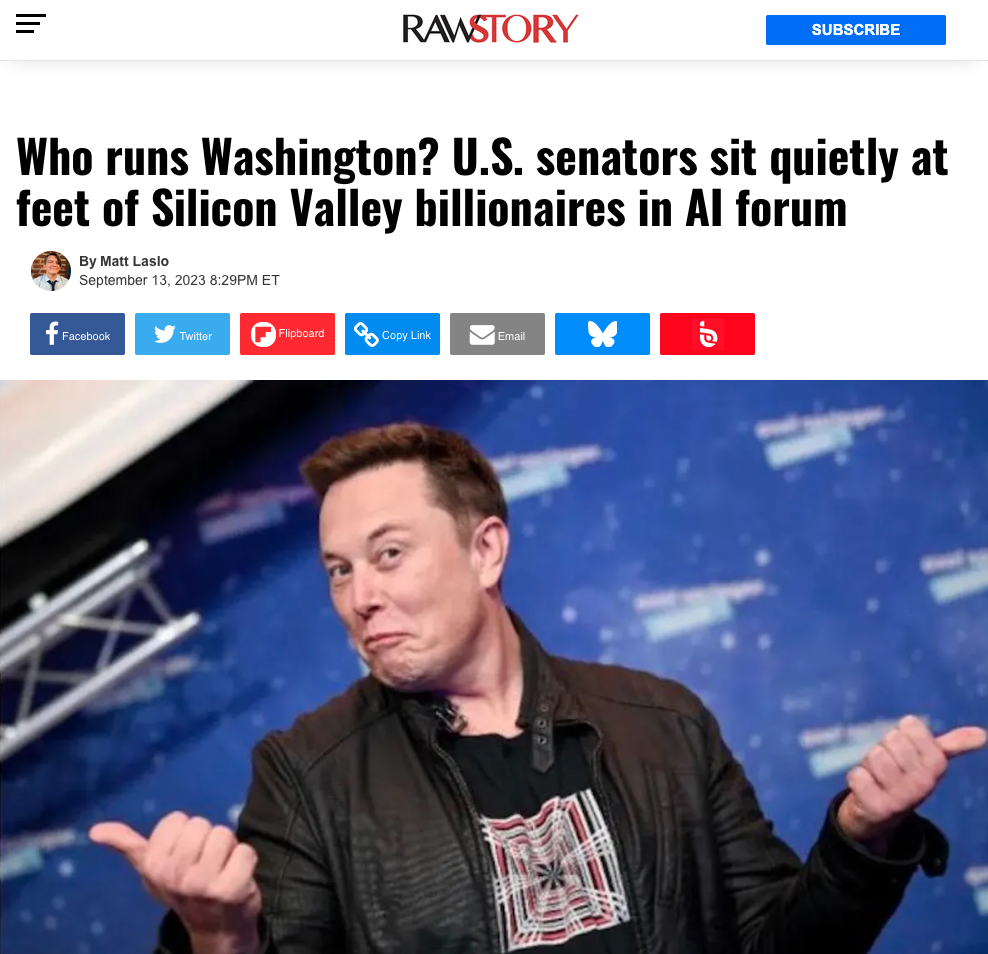
While, say, AFL-CIO labor federation President Liz Shuler was only flanked by a couple staffers, Capitol Police officers shut down three-stories of public hallways in the Russell Senate Office Building – a public building – when Tesla CEO Elon Musk exited.
Senators walk through Senate Office Buildings alone or with a staffer or two. Musk was escorted through the highly secure building flanked by four Capitol Police officers – on top of his three, black suit and tie-donning private security detail – and then upward of 10 stood guard outside as he paused to talk to reporters before taking a Tesla to a meeting he said he had at the FAA.
Raw Story asked Schumer about Musk’s taxpayer-funded escort.
“Did you know Capitol Police were shutting down public hallways for these CEOs?”
“I did not,” Schumer said.
“And is it a good use of taxpayer dollars to have 10 Capitol Police officers escort Elon Musk out?”
“I leave safety issues up to Capitol Police,” Schumer replied.
Schumer quickly moved on to other questions, and requests for comment from the Capitol Police were not returned. But when Raw Story described the scene to Schumer’s fellow New Yorker, Rep. Jamaal Bowman (D-NY), there was no hesitation.
“America is also an oligarchy. We talk about oligarchy from the perspective of Russia — America has an oligarchy,” Bowman told Raw Story. “What you just described is a clear example of that. Citizens United is a clear example of that. And that's why our H.R. 1, getting big money out of politics and dark money out of politics, is such a priority for us.”
RELATED ARTICLE: Deepfake democracy: How AI is bamboozling Congress and threatening Election 2024
Other senators were surprised to learn they wouldn’t be able to question the assembled witnesses – including the likes of Meta’s Mark Zuckerberg, OpenAI founder Sam Altman, former Microsoft CEO Bill Gates – but once informed, they just assumed Schumer gave deference to all the big-name speakers he assembled.
“Oh, well, that might have been a nod to some of the people who are here, so that they would not get challenged,” Sen. Cynthia Lummis (R-WY) told Raw Story.
Still, Lummis was pleasantly surprised by how informative the closed-door AI meeting was, including Musk’s warning to the Senate of the “civilization risk” AI poses.
“Which I was a term that I hadn't heard before,” Lummis said as she flipped through her notebook brimming with her studiously scribbled notes of the private forum. “He said, ‘AI is a double-edged sword and that we have to make sure we nurture the good side of that sword and find ways to address the bad side of that double-edged sword.’”
Lummis, like others, reported being introduced to many new concepts in the forum, like the need for AI audits (“I would have thought, as long as it’s open-source AI, that there's almost a natural audit function”) or that algorithms can reinforce discrimination (“how could an algorithm do that?”).
After missing all three all-Senate AI briefings that Schumer hosted over the summer, Lummis was “really glad” she went.
“I was worried about that, that it wasn’t gonna be worth the time because, you know, there's so many big names and so maybe it was going to be much ado about nothing because people wouldn't say things that were helpful to policymakers. They did,” Lummis said. “It was surprisingly, at least from my perspective, it was surprisingly helpful.”
Many Democratic attendees praised the private forum as well.
“It was pretty cordial. I thought there'd be a lot of sniping, and it really wasn't,” Sen. John Hickenlooper (D-CO) told Raw Story as he left the the forum after listening to more than two hours of three-minute opening speeches from all those assembled on the dais.
While Schumer hosted the event, one of Senate Minority Leader Mitch McConnell’s top lieutenants, Sen. John Cornyn (R-TX), was also pleased with how it went.
“I think rather than what’s said, I think the fact that that meeting’s occurred at all is probably the most significant,” Sen. John Cornyn (R-TX) told Raw Story. “Just because those people don't sit down and talk to each other. They're competitors, and so knowing of the interest of policymakers that, I think, will cause some additional conversations and that hopefully will be helpful.”
Even so, Cornyn – who’s seen as a top contender to replace McConnell as GOP leader one day – knows the tough road ahead.
“But the problem is Congress is slow as a glacier at actually passing legislation,” Cornyn said. “And I don't think the technology is going to wait.”
AI surely won’t wait, and Senate critics say today they lost precious time in assessing where they agree and disagree with their own colleagues – an essential information gathering tool if a compromise is ever to be forged in these hyper-partisan times.
“There's no feeling in the room. Everything just passed by. There’s no interaction. No bumping against each other on any of these issues,” Warren of Massachusetts complained.
The other thing is, senators – some unwittingly – surrendered one of their biggest powers at the feet of these titans of Silicon Valley, because not a single tech CEO can commit perjury if they’re never sworn in.
“I'd prefer them all being under oath and testifying. That’s how you do it. We have a mechanism to gather information in Congress, we have hearings,” Sen. Hawley of Missouri lamented. “But if we're not going to do that, at least it should be open to the public.”
LCB founder Matt Laslo’s generative AI, or artificial intelligence, exclusive for Raw Story on Big Tech billionaires trying to buy Congress.