Miami’s WLRN: Why Some South Florida Lawmakers Remain Opposed To Normalized Relations With Cuba
By Matt Laslo
Former Speaker of the House Nancy Pelosi recently brought a handful of Democrats with her to Cuba – a trip she calls a sign of “friendship” between the U.S. and the island nation that remains under a congressionally mandated embargo.
Democratic Sen. Mark Warner – a businessman and former governor of Virginia – also recently ventured down to the island, accompanied by two other Democratic senators whose states sell a lot of agriculture products to Cuba. Warner says the Cuban government uses the embargo as an excuse for why the nation is so poor.
“Opening up relations and removing the embargo the Cuban government moves forward and the American government moves forward I think would take away that excuse the regime has had,” Warner says. “I think this could be a strong trading partner with us and also would help us improve relations with countries all across the region.”
A group of Republican senators are planning a similar trip to the island soon. While the Obama administration and its allies on Capitol Hill are moving forward with attempts to normalize relations with Cuba, that’s angering some South Florida lawmakers on both sides of the aisle.
Florida’s senior Sen. Bill Nelson, a Democrat, says the Castro government is happy to have allies come visit, but it shuts out voices of dissent.
“They won’t even let me into the country,” Nelson says. “I tried to get in to see Alan Gross in prison. They won’t give me a visa to come in.”
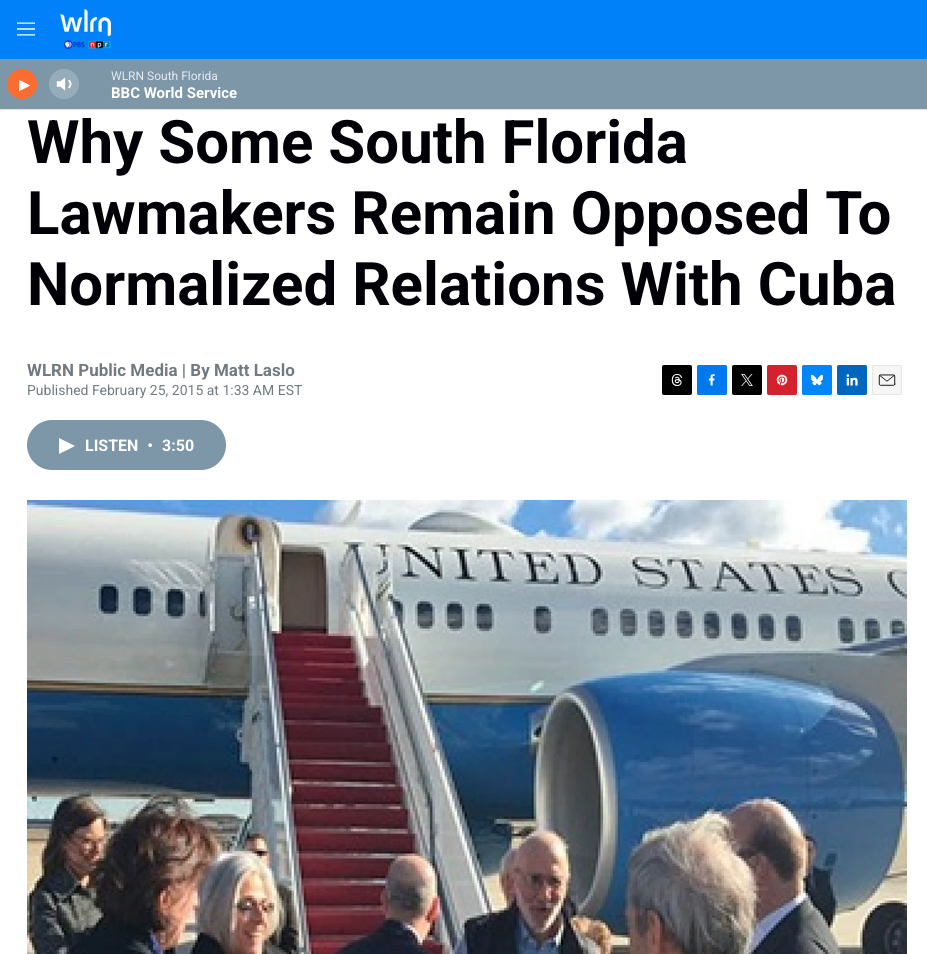
Gross has since been freed after being imprisoned five years for providing Jewish communities on the island with communications equipment. That should serve as an example to lawmakers who want to lift remaining trade barriers with Cuba, Nelson says.
“Well, when they start giving better human rights -- the Castro boys -- then I’m willing for more trade,” Nelson says.
But lawmakers in both parties on Capitol Hill are increasing their calls to ramp up trade with Cuba.
Debbie Stabenow, the top Democrat on the Senate Agriculture Committee, says removing trade barriers with Cuba will help her state export everything from cherries to sedans.
“This is an island 90 miles off of our southern border. It’s a great opportunity for folks like my farmers in Michigan to sell as well as automobiles,” Stabenow says. “We’ve all seen the famous cars [from] the 50s, and after being there a couple of times I can tell you they could sure use some Michigan-made automobiles. “
Florida Republican Senator Marco Rubio says even though more lawmakers are traveling to Cuba these days, he doesn’t see the winds changing on Capitol Hill.
“That’s not new,” Rubio says. “You’ve always had members from agricultural states that are always looking for markets for their constituents.”
Stabenow says the majority of Cuban dissidents she’s met with also support lifting the 50-year-old embargo. She thinks democracy will come through normalized relations, but Rubio disagrees. He says the Obama administration and a handful of lawmakers are putting dollar signs over human rights.
“My interest in Cuba is about human rights and democracy. I’m not willing to put that aside for some sort of theoretical economic benefit that I’m not sure is real anyway and that I wouldn’t trade for human rights and democracy anyway,” Rubio says.
South Florida Rep. Mario Diaz-Balart says there’s another problem when it comes to trading with Cuba: it’s not a free market.
“There’s a high risk, it’s a very risky thing to do any business, any investment there because they won’t pay and by the way they will also then confiscate your business and arrest you,” Diaz-Balart says.
The three conditions Congress placed on Cuba when it passed the embargo still need to be met, Diaz-Balart says, before he’ll embrace any changes to U.S. policy.
“Release all the political prisoners,” he says. “Allow for some basic freedoms – freedom of press, independent labor unions, political parties and then call for free elections. When those three things happen – all the sanctions go away.”
LISTEN at WLRN.