BREAKING — VICE News: Musicians are begging Mitch McConnell to save live music before it’s too late
By Matt Laslo
An estimated 40 million Americans face eviction if Congress doesn’t act on another stimulus bill soon. But there’s another group potentially facing an existential crisis without federal assistance during the pandemic: America’s live-music venues.
Roughly 90% of smaller, independent music venues – most of whom weren’t eligible for federal stimulus funds, or PPP, because without live shows there was no staff to retain – have been warning for months that they’re on the brink of closing permanently if they don’t get direct support from Washington.
And that’s spurring some unlikely conversations, including a private call between Senate Majority Leader Mitch McConnell of Kentucky and members of the Louisville rock band My Morning Jacket pleading with him to save the music industry; and another, similar call last week with McConnell’s chief of staff, members of My Morning Jacket, and Kentucky artist Sturgill Simpson.
Their ask? Make music venues eligible for Paycheck Protection Program loans. They were excluded from that part of the CARES Act, as most venues closed early in the pandemic and had to let their staffs apply for unemployment — and they’ll be among the last businesses to reopen. That is, if they’re still around. Which is why they’ve been talking to McConnell.
“We feel confident that we delivered our message as strongly as possible,” Eric Mayers, a manager at Red Light Management, which reps My Morning Jacket, said in an email to VICE News. “The meeting detailed the unique plight faced by the U.S. arts sector and the necessity of arts-specific federal relief to tide it through the ramifications of COVID-19.”
The Kentucky senator’s office has been bombarded with over 6,000 emails and an array of phone calls from (mostly) his constituents on this specific issue. Still, McConnell — who’s up for reelection this cycle — didn’t have anything to say when we asked how his chamber’s inaction is hurting Kentucky’s vibrant music scene, which has also given us acts like Cage the Elephant, Morning Teleportation, and even Tantric.
McConnell excluded venues — and thus the musicians who get roughly 75% percent of their income from live shows – from the Senate GOP’s $1 trillion proposal. And he apparently wasn’t swayed enough by the bands’ pleas to pass that message along where it mattered: He wasn’t even in negotiations with Democratic leaders and the White House last week. Robert Steurer, communications director for McConnell’s personal Senate office, dismissed our request to know what McConnell thinks of his home-state artists’ message. “We don’t read out calls,” he said, “And if there’s anything to add, I’ll let you know.”
But with a steady stream of beloved venues going under, many musicians are battling a range of emotions, from anger at the political class to despair over the future of American music.
“My first experience was going to see a club show,” Wesley Schultz, the lead singer and guitarist for the Lumineers, recounted to VICE News of his time seeing The Samples live at New York’s iconic Irving Plaza. Since then, Schultz and his mates sold out Madison Square Garden on their first arena tour in 2016. But you can’t get to the Garden without learning how to perform live at hole-in-the-wall clubs and then medium-sized ones before opening for bands at big-box venues, like Irving Plaza.
“There’s nothing quite like it,” Schultz said. “You’re not really allowed to hide behind any tricks or gimmicks. It’s kind of, you are what you are on those stages. And I think it’s why a lot of bands cut their teeth and get better in those environments.”
While the Lumineers played an event on the White House lawn when Barack Obama was in office, like most artists, Schultz doesn’t wade into politics much. But saving venues isn’t political.
It’s not political
“It shouldn’t even be this thing of like: ‘Whose side are you on?’ This is, like: Everyone likes this. This is like saying, ‘Do you like ice cream?,” Schultz said. “It’s just getting enough attention of somebody, waving your arms enough to say, ‘Remember this!? Remember this!?!’ Because if we don’t, they’re done.”
President Trump’s four new executive orders still don’t include local music venues in loan programs, but those orders are already raising constitutional concerns even from some Republicans, because Congress controls the federal pursestrings, not the White House.
Meanwhile, the music industry, on the verge of a government-mandated collapse, has no time for drawn-out court battles. But there’s still a glimmer of hope if the two sides of this political spat can get back to the negotiating table. Legislation that would add local music venues to those eligible for federal assistance include the RESTART Act, which now has a bipartisan assortment of 54 co-sponsors in McConnell’s gridlocked Senate alone.
There’s another proposal picking up bipartisan support that’s aimed directly at music venues and the artists who rely on their spaces: the Save Our Stages Act, which has the bipartisan support of 22 Senators and 55 House members.
It creates a $10 billion loan program targeted specifically for venues, producers, promoters and managers whose businesses are tied to concerts. Its lead Democratic sponsor in the House says it’s essential if political ‘leaders’ don’t want to set American music – along with all the creativity and inspiration it fosters – back years, if not decades.
‘Empty shells’
“These venues are going to be the last to reopen – they’re going to need a vaccine before people are safe. We want to make certain that when the lights go back on, they’ll be there,” Rep. Peter Welch, Democrat of Vermont, told VICE News. “We don’t want to come out of this with empty shells and vanished live venues, with no place for our artists to get started.”
Part of the reason local music venues were left out of the first three pandemic bills is that unlike the powerful National Restaurant Association, local music venues had no organized presence in Washington. But that changed with the formation of National Independent Venue Association (or NIVA), which formed this spring after quarantine orders nationwide shuttered venues of all sizes, leaving the artists who rely on them locked out of their night gigs. That’s expected to leave a $9 billion hole in the economy, according to Pollstar. The new group now includes 2,500 clubs from all 50 states and the nation’s capital.
The group hired Akin Gump, one of Washington’s most prominent lobbying shops. Local venues used their sacred email lists to drum up support while also getting more than 600 artists – from Lady Gaga and Lizzo to Wyclef Jean and Willie Nelson – to either pen letters pressuring lawmakers or use their expansive social media reach to whip up support.
To date, more than 1.5 million emails have been sent to lawmaker’s inboxes, including McConnell’s.
“This grave situation can’t be put on ice and addressed when Congress gets back from August recess. It would be like giving a liver transplant to a cadaver,” Audrey Fix Schaefer, Director of Communications for the National Independent Venue Association (or NIVA), told VICE News. “We need all the players on both sides to set aside politics, or this ship will sink – and everyone will go down with it.”
With the Capitol closed to the public, the group even split the nation into 48 different precincts. A venue owner in each area serves as the captain charged with spearheading an all-out pressure campaign on regional lawmakers. And even with lawmakers now on their August recess, the group is vowing to keep making their voices heard, and they’ve cultivated some allies in Congress, like Rep. Welch.
As for his proposal’s prospects?
“Everything’s hard,” said Welch, the lead sponsor in the House. “Everything is hard.”
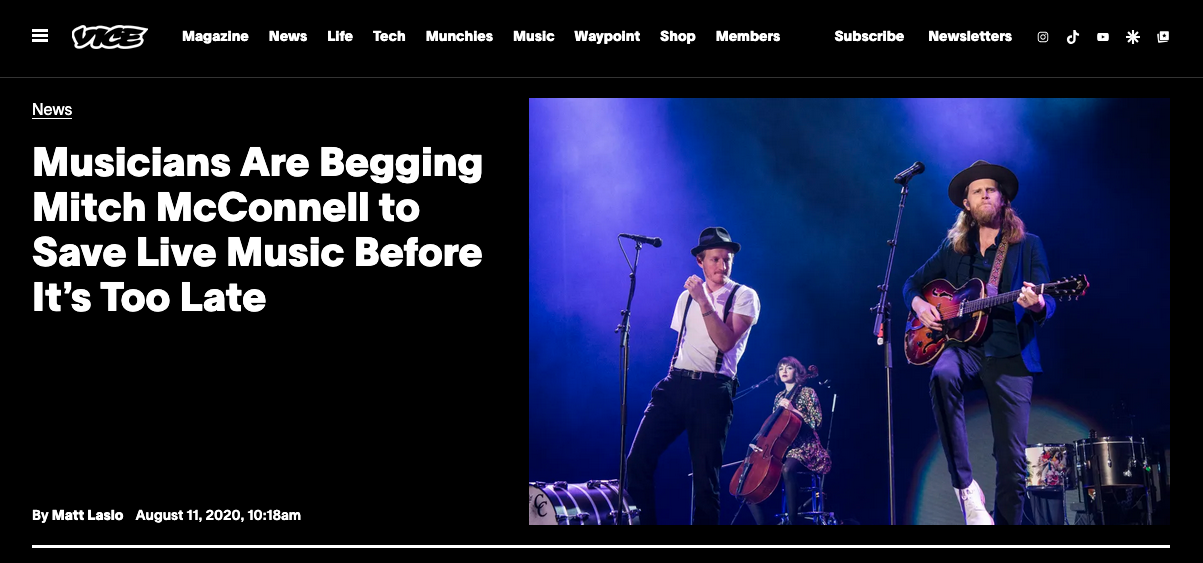
Cover: Jeremiah Fraites, from left, Neyla Pekarek and Wesley Schultz of The Lumineers perform at the 2017 KROQ Almost Acoustic Christmas at The Forum on Sunday, Dec. 10, 2017, in Inglewood, Calif. (Photo by Amy Harris/Invision/AP)